Artificial Intelligence in Medicine: A Hands-On Guide for Clinicians
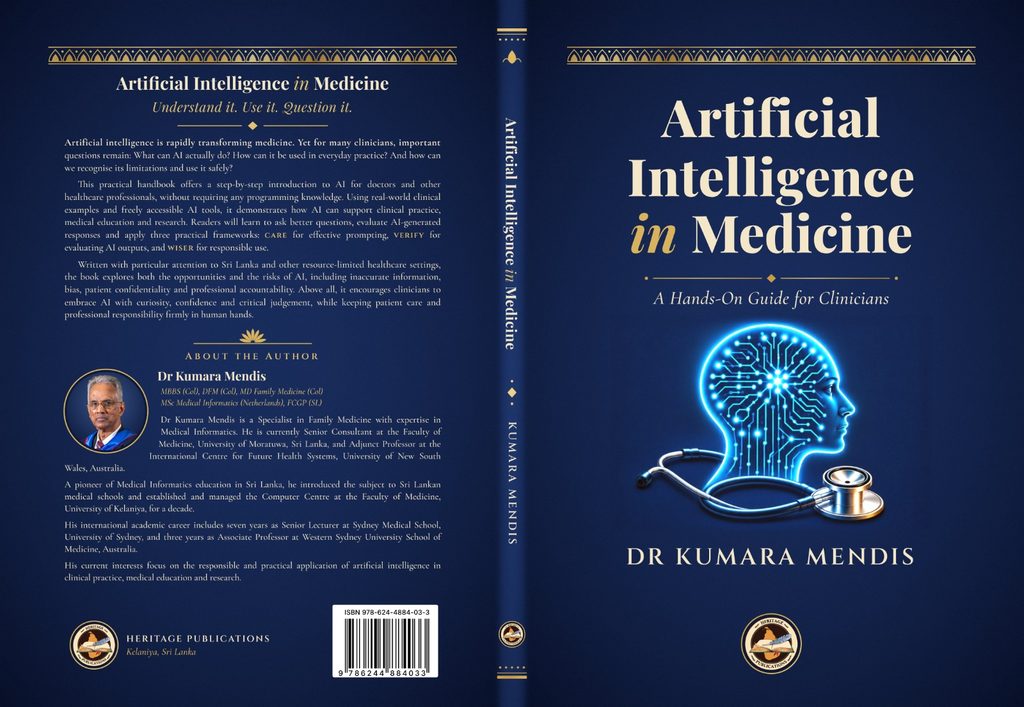
About the book
AI tools are already in your patients’ pockets, and probably in your own. This book is a practical guide to using them well. It shows how AI can make clinical work, teaching and research easier and safer, and it is just as clear about where AI fails.
It is written for doctors in Sri Lanka and other low- and middle-income countries. Most readers will have no background in computing and a limited budget for subscriptions in US dollars. The examples come from local practice: dengue, leptospirosis, CKDu, district and base hospitals, and the national formulary. Every exercise works on free tools, and none of them needs an international credit card.
There are twelve short chapters with little theory and plenty of practice. Each chapter has a worked walkthrough and a “Now You Try” exercise, and the book closes with a pull-out quick-reference section. It is meant to sit on your desk, not your bookshelf.
Who it’s for: doctors who are sceptical but open-minded, clinical teachers, postgraduate trainees and MD candidates, and anyone who wants to use AI safely without first becoming a technologist.
What you’ll be able to do
- Write prompts to get meaningful answers to your questions. You’ll learn the CARE framework (Context, Action, Role, Examples/Format) when using LLMs such as ChatGPT for clinical, teaching and research tasks
- Learn and use free tools for your clinical practice. You’ll get practical workflows for using AI tools which gives a differential diagnosis and treatment plans based on current evidence
- Use AI tools for medical education and research. From designing a power point presentation to a literature review use of free-tier tools that has a short learning curve.
- Judge AI tools for yourself. An 8-domain evaluation framework helps you decide whether a new product is safe and worth your time.
- Understanding the limitations and risks of AI. A detailed aspects of how you need to safely use AI with its limitations and risks such as hallucinations, biased datasets, ethical, consent and regulatory aspects
- Foresight about the future of AI. With exponential development of AI tools what clinicians in Sri Lanka can expect from AI tools
About the author
Dr Kumara Mendis (MBBS, MD, MSc, FCGP) is a Board Certified Specialist in Family Medicine and a Senior Consultant at the University of Moratuwa, Sri Lanka. He is a medical author, educator and researcher whose work focuses on the safe and fair use of artificial intelligence in clinical practice. He wrote the Ceylon Medical Journal leading article “Artificial Intelligence in Medicine: is it a panacea for all ills?” (2023), co-edits the SLMA Newsletter and reviews for medical journals. His frameworks for AI prompting, verification and tool evaluation (CARE, VERIFY and the 8-domain evaluation) were developed with doctors working in low- and middle-income settings in mind.
Photograph: [your headshot — a plain or softly blurred background works best; a square crop of at least 800 × 800 px]
Publication details
- Publisher: [TBC]
- Publication date: [TBC]
- Format: Paperback, approx. [xxx] pages [plus ebook?]
- Price: LKR [xxx] [and USD [xx] for overseas buyers, if relevant]
- ISBN: [TBC]
- How to order: [bookshops / publisher link / direct order form / bank transfer details]
Until the details are confirmed, you could put a “Register your interest” button here that collects email addresses, so readers can be told when the book is available.
Launch event
[Date, time, venue, format (in person / online / hybrid), registration link]
For now, a placeholder line would do: “A launch event is being planned for [month]. Register your interest to receive details.”
Institutional and bulk orders
Ordering for a hospital, medical faculty, postgraduate institute or professional college? Discounted bulk pricing and workshop packages are available. [Contact us →] (mailto: or a contact form at [your email])
There’s one thing to check before this goes live. The Anchor Brief uses the subtitle “A Hands-On Guide for Clinicians”, but some earlier notes say “A Handbook for Clinicians”, so make sure the website uses whichever one will be on the cover. Also confirm that the University of Moratuwa title and the CMJ article are described the way you want them shown publicly.
0 Comments